What is Handbooks?
One codebase in, two handbooks out — a narrated documentation site your team reads, and a location index your coding agent routes with. Built from the same parsed map, kept current as the code moves.
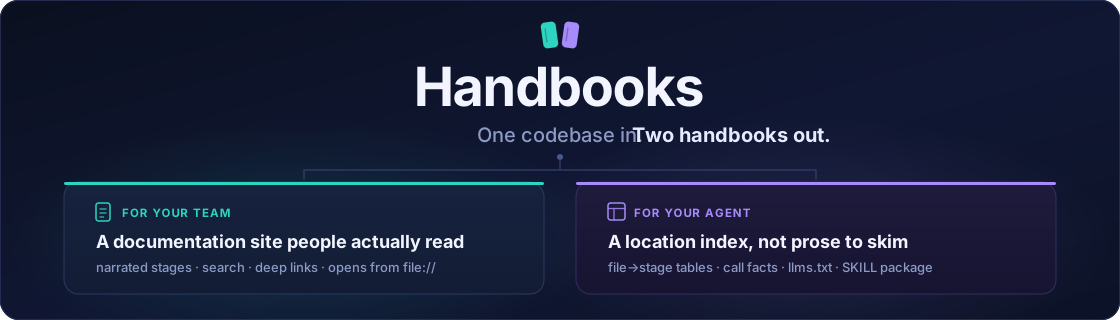
One codebase in. Two handbooks out.
Handbooks writes the same map of your code down twice, because it has two very different readers:
📖 The handbook for humans
A narrated, stage-by-stage documentation site — search, theme, deep links — generated from your code and openable straight from file://. You read this one.
🤖 The handbook for AI
A machine-shaped location index: file→stage routing tables, per-function call facts, llms.txt, and an installable SKILL package. Your coding agent reads this one.
Same facts underneath — a parser-built call graph — so the two can never disagree about what the code does. One optimises for narrative and navigation, the other for routing and staleness detection.
The problem, stated plainly
You have a repository. It is too big to hold in your head, and too big to hold in a context window.
Ask a coding agent to "retry failed uploads three times" and it will confidently patch the one upload function it found — and miss the retry-policy constant, the mirrored implementation in the batch worker, the metric that counts attempts, and the test that asserts the old behaviour.
That is not a reasoning failure. It is a routing failure. The agent never saw a map.
The one-sentence version
Handbooks reads your code with a real parser, builds a map of it, hands that map to the agent as a location index — not a summary — and keeps the map current as the code moves.
Try it before you read any further
Nothing below matters if it does not run. This takes about thirty seconds, spends zero tokens, and needs no API key:
git clone <this repo> && cd handbooks
pnpm install && pnpm build
pnpm demo
pnpm demo runs the entire toolchain against a bundled sample project using a bundled
mock LLM server. When it finishes you will have a rendered handbook, an HTML site, an
agent index and a validated SKILL package sitting on disk.
The three ideas it is built on
1. Facts come from a parser, not from a model
Handbooks parses every source file with tree-sitter and
builds a typed call graph: functions, methods, call edges resolved through
self/attributes/parameters/imports, calls that leave your code, and calls it could not
resolve — quarantined into their own file, never guessed at.
Files it could not read or parse at all are quarantined the same way — a gap you can enumerate, never one that silently disappears.
This layer never touches an LLM. Run it twice, get the same graph twice.
2. Prose is layered on top of facts, and labelled
An LLM writes the human-readable part: what a file is for, how a subsystem hangs together, which state flows across which stages. It is always anchored to the graph, and where it fails, the structure still ships — with an empty description.
A missing sentence is better than an invented one.
3. The map is built for routing, not for reading
The output is not a summary of your code. It is an index that answers "which files, functions and state does this change have to touch?" — including the scattered, non-obvious ones. The planner then uses that index, reads the real source at every address it found, and emits an edit plan byte-exact enough to apply mechanically.
What one run gives you
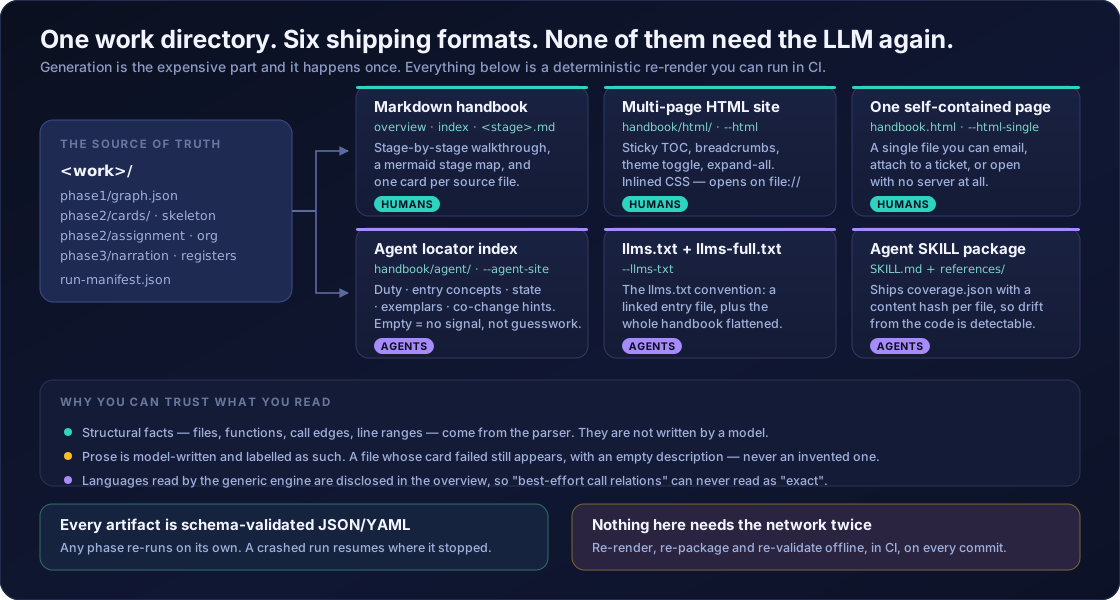
| Output | Who it is for |
|---|---|
| Markdown handbook — overview, stage index, one page per stage, state-register table | humans |
Multi-page HTML site — sticky TOC, breadcrumbs, theme toggle, works over file:// | humans |
| One self-contained HTML page you can email | humans |
Agent index — symbol → path:line-line, file and call tables, grep recipes | agents |
llms.txt + llms-full.txt | agents |
| A SKILL package with a content hash per file, so drift is detectable | agents |
Who this is for
| You are… | You get… |
|---|---|
| An engineer who just inherited a 200k-line service | A stage-by-stage walkthrough you can actually read, plus an HTML site to share |
| Someone running a coding agent on a big repo | A SKILL package that stops the agent guessing where things live |
| A team lead onboarding people | Documentation that regenerates instead of rotting |
| Someone maintaining a polyglot monorepo | One pass over 18 languages, with the analysis fidelity disclosed per language |
What it costs you
- Node.js ≥ 20.11 and pnpm. That is the whole install. No native compilation, no
Python, no
node-gyp— the parsers are WebAssembly. - An OpenAI-compatible endpoint for the LLM phases. Hosted OpenAI, Azure, vLLM,
Ollama, LiteLLM, an internal proxy — anything that speaks
/v1/chat/completions. It can be a model running on your own machine. - Nothing at all for
handbook analyze, which is the command you should run first.
Does my code leave the building?
Phase 1 is entirely local. Phases 2 and 3 send file contents to whatever endpoint you configured — which
can be localhost. Nothing else leaves, and --max-chars-per-file caps how much of any single file is ever
sent. See the trust model.
Where to go next
Why this exists
The routing problem, and why summarizing a codebase does not solve it.
How generation works
Five phases, what each costs, and what degrades when one fails.
Configuration
Flags, env vars, .env cascades and handbook.config.yaml — one registry.
Troubleshooting
The things that actually go wrong, and what to do about them.