Architecture
Eleven packages in four layers, a strictly one-way dependency direction, and the boundaries that make the deterministic half reusable on its own.
The layering
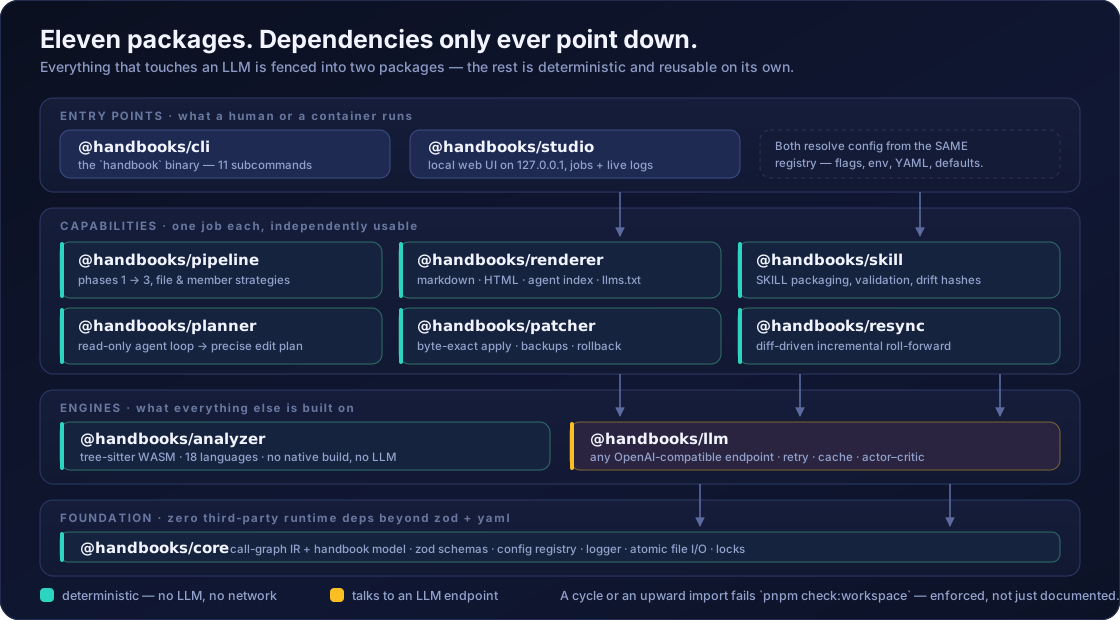
| Layer | Packages | Job |
|---|---|---|
| Entry points | cli, studio | What a human or a container runs |
| Capabilities | pipeline, renderer, skill, planner, patcher, resync | One job each, independently usable |
| Engines | analyzer, llm | The two things everything else is built on |
| Foundation | core | Data model, config registry, utilities |
Dependencies only ever point down:
cli → pipeline / renderer / skill / planner / patcher / resync → analyzer / llm → coreThree rules that keep it healthy
1. One-way dependencies, enforced
core imports nothing internal. Nothing imports cli. A cycle or an upward import fails
pnpm check:workspace, which also verifies that every package's TypeScript project
references mirror its package.json dependencies exactly — a missing reference makes
tsc -b build in the wrong order, and a root build hides it.
2. LLM isolation is a package boundary, not a convention
Only llm, pipeline, planner and resync may talk to a model, and only through the
ChatClient interface:
interface ChatClient {
  readonly model: string;
  complete(prompt: string, options?: ChatOptions): Promise<ChatResult>;
}analyzer, renderer, skill and patcher do not depend on @handbooks/llm at all.
They are fully deterministic and reusable with no LLM anywhere in sight. That is why
render, skill, validate, apply and rollback are free to run in CI.
It is also why the entire test suite runs offline: one seam, one mock.
3. The renderer boundary is a type
HandbookModel (defined in core) is the only thing the renderer knows about. It never
reads pipeline internals.
interface HandbookModel {
  title: string;
  lang: NarrateLang;
  skeleton: Skeleton;
  cards: Record<string, FileCard>;
  assignment: Assignment;
  organization: Organization;
  narration: Narration;
  registers: RegisterEntry[];
  provenance?: { commit?: string; generatedAt: string };
}
Any producer that can fill a HandbookModel gets rendering, skill packaging and
planning for free. If you want to generate a handbook some other way, that is the whole
contract you have to satisfy.
Data flow
source tree
   │  analyzer — tree-sitter WASM, one adapter per language
   ▼
phase1/graph.json · functions.csv · graph.dot · dropped-calls.json · scan-coverage.json
   │  pipeline 2a — cards (batched LLM, three-tier degradation, resumable)
   ▼
phase2/cards/<rel>.json + _coverage.json
   │  pipeline 2b — skeleton synthesis (+ doctor loop) + file assignment
   ▼
phase2/skeleton.yaml + assignment.json
   │  pipeline 2c — call-graph topological order + LLM grouping (flat fallback)
   ▼
phase2/organization.yaml
   │  pipeline 3 — bottom-up narration + register extraction (content-hash cached)
   ▼
phase3/narration.json + registers.json
   │  loadHandbookModel()
   ▼
HandbookModel ──▶ renderer ──▶ handbook/  (md · html/ · handbook.html · agent/ · llms.txt)
                     │
                     └──▶ skill ──▶ SKILL.md + references/ (+ coverage.json)
The work-directory contract: every phase reads only its upstream artifacts and writes
only its own, all schema-validated on read with a version field. Any phase can be re-run
alone. Crashes resume — cards are written per batch, narration is content-hash cached.
The human artifact explains; the agent artifact locates
One HandbookModel, two outputs with genuinely different jobs — and the split is the
design, not a packaging detail.
The markdown and HTML handbooks are written to be read: prose, ordering, a narrative
spine. agent/ is written to be grepped: symbols.tsv answers "where is
sendPayment defined" in one line, which no amount of prose does.
They used to be the same prose in two shapes, and the cost was concrete: the agent index came out 2.1× the size of the human index while containing no symbol locations at all, because 42% of it was model prose copied byte-for-byte from the human pages. Now the agent side carries facts and one clipped line of prose per file; where the explanation is needed, each stage page links to the human page instead of duplicating it.
Inside the analyzer
Each language implements one LanguageAdapter: discover, analyze, and optionally
statementSpans. Every grammar is WebAssembly, so installation never compiles native
code.
Adapters run two passes per module:
- Scan — declarations, imports, classes and methods, and per-function facts:
signature, line range, async-ness, decorators,
self/thisattribute reads and writes, typed parameters, and attribute types learned from constructor assignments. - Resolve — every call site becomes a typed edge:
self_method,self_attr_method,param_method,internal_func,internal_constructor,boundary,boundary_constructor— orunresolved, which the graph builder quarantines intodropped-calls.jsonwith a category.
The kept graph only ever contains resolved, named callees. That is what makes an edge in it trustworthy.
The same rule applies one level up, to whole files. A file the adapter could not read, or
whose grammar threw, or which parsed with syntax errors, is recorded in
scan-coverage.json with its reason — and the first two are kept out of
scannedFiles, so no later phase can describe a file the parser never saw.
The nav-pack is a deterministic orientation summary derived from the graph — directory rollups, entry-point candidates, fan-out, external subsystems. It is the only view of the codebase the skeleton synthesizer sees, which keeps that prompt small and grounded.
The pipeline's quality machinery
Three-tier card degradation (2a). Whole batch → single file → per-function chunks for
oversized files. Files that still fail get an honest empty card and are listed in
_coverage.json. Coverage is complete by construction; misses are visible rather than
silent.
Actor–critic skeleton doctor (2b). The actor proposes at most three structural changes
against ground-truth stats; three role-played critics (engineer, architect, reader) review
in parallel; every surviving change is re-validated mechanically before it is applied;
affected files are re-assigned. The loop stops on convergence or two no-progress rounds.
A broken critic counts as REJECT — a failing reviewer must never wave changes through.
Deterministic fallbacks everywhere (2c, 3). Organization falls back to call-graph order. Narration falls back to the stage description. Register extraction failure yields an empty list. A generation run degrades; it does not block.
Content-hash caches (3). Stage and system prose is cached under phase3/cache/, keyed
by prompt version, language and the full prompt hash — so re-runs and resyncs pay only for
what actually changed.
Concurrency and safety
- One run per work directory.
generateHandbookandresyncHandbooktake the same re-entrant directory lock, so a CLI run and a Studio job cannot interleave writes on the same artifacts. - Atomic writes. Every artifact is written to a temp file and renamed. A crash never leaves a half-written file for the next run to choke on.
- Cooperative cancellation. An
AbortSignalis checked between phases and at every batch checkpoint, and threaded into every LLM call so in-flight requests abort. An aborted run keeps what it saved and writes no run manifest.
Decisions worth knowing
| # | Decision | Why |
|---|---|---|
| 1 | WASM-only tree-sitter | Zero native builds; one loading path for every language; version-locked grammars |
| 2 | Hand-rolled fetch LLM client | OpenAI-compatible endpoints vary; a thin client with explicit retry beats an SDK dependency. The interface seam matters more than the transport |
| 3 | One pipeline, two strategies | Separate large/small pipelines duplicate adapters, critics, clients and renderers; a strategy flag removes about 40% of that surface |
| 4 | zod-validated artifacts with version | Corrupted or hand-edited artifacts fail loudly at the boundary instead of poisoning later phases |
| 5 | Facts/prose separation in cards | The model annotates a complete graph-derived inventory. Prose can be empty; facts cannot be wrong |
| 6 | Single-turn planner protocol | Works on any endpoint, trivially mockable, and the transcript is inspectable. The cost — re-sending tokens — is acceptable at planner scale |
| 7 | ESM + tsc -b, no bundler | Libraries ship type-checked dist/ and .d.ts; composite references give incremental builds with zero extra tooling |
| 8 | One configuration registry | Flags, env names, YAML keys and three generated documents all derive from one table, so they cannot drift |