Configuring Handbooks
Five precedence layers, one registry, and a command that tells you exactly which layer won.
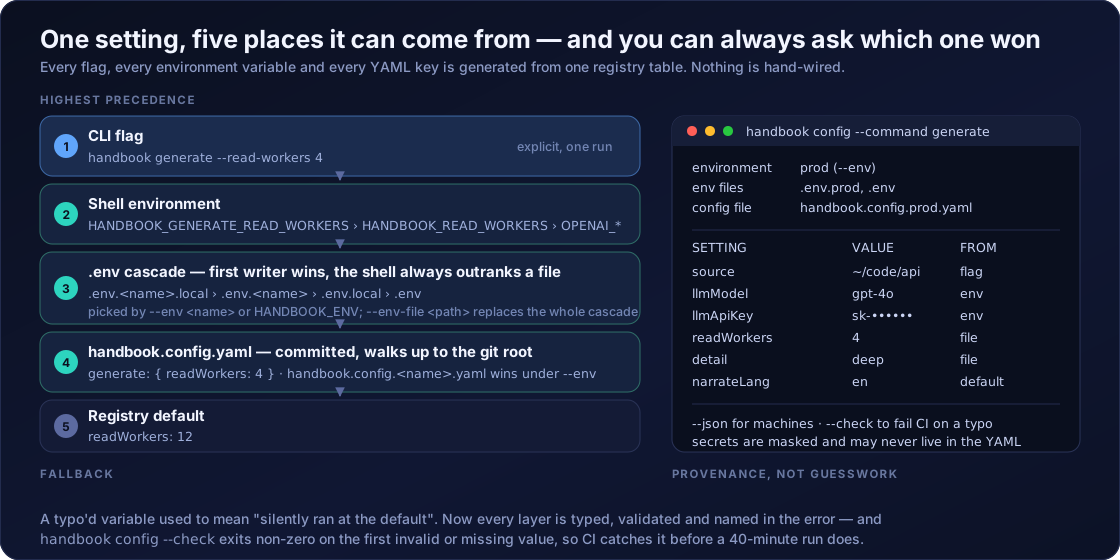
Every setting is declared once, in one registry table. The CLI flags, the environment
variable names, the config-file keys, .env.example, handbook.config.example.yaml and
the configuration reference are all generated from it —
so they cannot drift apart, and a drift test fails the build if anyone tries.
Precedence, highest first
- CLI flag —
--read-workers 4 - Shell environment —
HANDBOOK_GENERATE_READ_WORKERS, thenHANDBOOK_READ_WORKERS, then a vendor alias likeOPENAI_MODEL - The
.envcascade — merged into the environment before anything reads it handbook.config.yaml— discovered by walking up from the cwd, stopping at the git root- Registry default
The first layer that supplies a value wins; every layer below is ignored for that setting.
handbook.config.yaml
Put it at the repository root and commit it. Discovery walks up from the working directory and stops at a repo boundary — so a project with no config file does not inherit its parent's.
# Paths are resolved relative to THIS FILE, so the config stays portable.
source: ./src
work: ./.handbook

llm:
  model: gpt-4o-mini
  baseUrl: https://api.openai.com/v1
  maxTokens: 16000
  concurrency: 16

generate:
  detail: deep
  synthMode: doctor
  narrateLang: en
  readWorkers: 12

render:
  title: Payments API Handbook
  html: true
  agentSite: true
  llmsTxt: true
  sourceBaseUrl: https://github.com/me/api/blob/main

studio:
  port: 4860
Two things to know:
- Nesting and flattening are the same thing.
generate: { detail: deep }and a flatgenerateDetail: deepmean exactly the same, because the file is flattened by camelCase join before it is read. - Relative
pathvalues resolve against the config file's own directory, not the cwd. That is what keeps a committed config file working no matter where you run the command from.
Secrets are rejected here
llmApiKey / OPENAI_API_KEY and llmExtraBody / OPENAI_EXTRA_BODY must never appear in a config file —
config files get committed. The loader refuses the file outright and says why. Put them in .env or the
shell environment. baseUrl is fine to commit, unless the URL itself carries credentials
(https://user:pass@host/v1), which is refused for the same reason.
Copy handbook.config.example.yaml to start; it is generated from the registry, so it
lists every key that actually exists.
Per-command scoping
Any setting can be scoped to one subcommand, on all three surfaces, with the same transform:
export HANDBOOK_NARRATE_LANG=en            # everywhere
export HANDBOOK_GENERATE_NARRATE_LANG=zh # …except generatenarrateLang: en
generate:
narrateLang: zhThe scoped form always wins over the flat one.
Multiple environments
handbook generate --env prod --source ~/code/api --work work/api--env prod (or HANDBOOK_ENV=prod) does two things:
- Loads
.env.prod.local→.env.prod→.env.local→.env, first writer wins. - Prefers
handbook.config.prod.yamlover the plain file — at every directory visited on the way up, so a named file beats a plain one even if the plain one sits closer.
A typical layout:
.env                     # team baseline, committed
.env.local               # your machine, gitignored
.env.prod                # team prod settings, committed (no secrets)
.env.prod.local          # your prod credentials, gitignored
handbook.config.yaml     # defaults
handbook.config.prod.yaml
--env-file <path> bypasses the cascade entirely and loads exactly that one file. A
missing file there is a loud error, not a fallback — you asked for a specific file.
Ask what actually resolved
handbook config --command generateenvironment prod (--env)
env files .env.prod, .env
config file /repo/handbook.config.prod.yaml
SETTING VALUE FROM
source /Users/me/code/api flag --source
llmModel gpt-4o env HANDBOOK_LLM_MODEL
llmApiKey sk-•••••• env OPENAI_API_KEY
readWorkers 4 handbook.config.prod.yaml (generate.readWorkers)
detail deep handbook.config.prod.yaml (generate.detail)
narrateLang en defaulthandbook config --json # machine-readable
handbook config --check # exit 2 on the first invalid or missing valuePut --check in CI
A typo'd variable used to mean "silently ran at the default". --check turns it into a failure with the
variable named in the message — much cheaper than discovering it forty minutes into a generation run.
config deliberately uses the non-throwing resolver: its job is to show configuration,
including when it is broken. A missing --source renders as a visible
— unset (required) row rather than taking down the one tool you would use to debug that
exact problem.
What the resolver enforces
-
An empty value reads as unset.
HANDBOOK_TITLE=cannot produce an untitled handbook. -
A supplied-but-invalid value never falls through to a default. A typo'd number is an error, not a silent 12.
-
Types are checked at the boundary, with the source named in the message:
env HANDBOOK_READ_WORKERS: readWorkers must be an integer >= 1, got "twelve" handbook.config.yaml (generate.detail): detail must be one of brief | deep, got "verbose" -
Required-ness is checked after every layer, and the error lists every way you could supply it:
source is required: pass --source, set HANDBOOK_GENERATE_SOURCE,
or add it to handbook.config.yaml